Friday, 21 November 2014

Writing a Screenplay

What is a screenplay?
screenplay
ˈskriːnpleɪ/
noun
noun: screenplay; plural noun: screenplays
  1. the script of a film, including acting instructions and scene directions.
     
Example of a screenplay
Buffy the Vampire Slayer - Welcome to the Hellmouth

FADE IN: EXT. SUNNYDALE HIGH SCHOOL – NIGHT
The front of the affluent Southern California school gleams darkly in the moonlight.         
CUT TO:INT. HALL – CONTINUOUS TRACK through the hall. Nothing.         
CUT TO:INT. CLASSROOM – CONTINUOUS
Silent. We track along the wall, past the maps and drawings tacked up on it, past the window, which SHATTERS in our faces! It’s just a single pane, knocked in by someone’s hand. It unlocks the window and slides it up. The intrude is a college age BOY, a timid GIRL beside him. She looks about nervously.
GIRL
Are you sure this is a good idea? BOY
It’s a great idea! Come on.
As they climb in.
CUT TO:
INT. HALL – A MOMENT LATER
He leads her out here. It’s even darker than the classroom
GIRL
You go to school here?
BOY
Used to.
On top of the gym, it’s so cool – you can see the whole town.
GIRL
I don’t want to go up there.
BOY
Oh, you can’t wait, huh?        
He moves to kiss her.
GIRL
We’re just gonna get in trouble
BOY
Count on it.        
He kisses her, but she turns suddenly, real fear crossing her face.         
GIRL
What was that?
BOY
What was what?
GIRL
I heard a noise.
BOY
It’s nothing.
GIRL
Maybe it’s something…
BOY
Maybe it’s some Thing...
GIRL
That’s not funny.


He looks about them. The place is dark, shadowy. She cowers behind him.
BOY
Hello…?


Silence.
BOY
There’s nobody here.
GIRL
Are you sure?
BOY
I’m sure.
GIRL
Okay…


She bares HORRIBLE FANGS and BURIES them in his neck.         

BLACKOUT.

What is the purpose of a screenplay?
The purpose of a screenplay is basically to tell you what will happen in the movie. It includes all of the dialogue and stage directions, and also informs actors and technical crew alike as to where the scene is currently set.


Our Task
Our task was to create the opening two minutes of a feature film inspired by a book. We could choose any book, as long as it had not previously been adapted for either film or TV.
As a group,  we finally chose the book 'Nineteen Minutes' by Jodi Picoult. We chose this book as our final decision, as it opens with a letter, which as a group we thought had a lot of potential when creating the opening 2 minutes.
We began by mind mapping our ideas for the film opening, and then once we had some ideas, we created a story board, that allowed us to communicate our ideas visually, rather than through words, like our mind map.

Once we had our storyboard, and we knew the rough outline of our film opening, we started to create a screenplay for our film.

As a group, our first major issue was that we had decided there would be no dialogue in the opening, making it slightly more difficult to communicate what was going on in the film as there was no script to accompany it. As part of our film, we were going to film words being typed on a screen, so we made sure that we included that in our screenplay, to make sure that the correct words were filmed during the production process. Also, because the entirety of the opening was to be set in one place, there was no change in location to describe, so it made our screenplay very short, however we soon realised that we didn't require a long screenplay for our opening, as the actor who would require it didn't need to be told a lot in their acting.


Nineteen Minutes - Screenplay 

INT. BEDROOM – MID-DAY
A typical messy teenage bedroom in Sterling, New Hampshire. It’s around 1pm in the afternoon. The room is very messy, with a bowl of half eaten cereal on the bedside table, and dirty socks on the floor.
There is a young man sitting at a desk in the corner of the room, whom is named PETER. He is typing on a laptop, and the audience can see the screen of his computer, as he clicks on an album on his screen, and music begins to play.
At this point, PETER continues to type away on his screen, as the audience realises that he is in fact typing a letter.
PETER
(typing on screen) By the time you read this, I hope to be dead.
PETER continues to type on his keyboard as we see other areas of his room.
PETER
(typing on screen) Don’t blame yourself
The typing continues as we see more of his room.
PETER
(typing on screen) That would be a lie.
The typing continues as we see his cupboards.
PETER
(typing on screen) You’ll cry at my funeral.
The typing continues as we see a clock, and hear it ticking.
PETER
(typing on screen) Will you miss me?
The typing continues, and we see a shot of a gun in the reflection of PETER’S glasses

Sunday, 16 November 2014

Film Opening - Drama - Detachment

 
The film begins with the 'paper street films' logo, which then fades to black for 3 seconds.  The use of this black screen helps separate the production company name from the beginning of the actual footage that is part of the narrative. A straight cut is then used to transition to a close up of a man holding  a pencil in his hand. Due to the fact he has a pencil in his hand, as an audience we start to make guesses and assumptions as to who this man may be, or the profession he has. He is talking to someone out of frame, and he sounds slightly fed up in his tone of voice. Due to the positioning of the man in the frame, and the use of  close up, it makes it feel slightly like a documentary. At 0:54

Saturday, 15 November 2014

Film Opening - Drama - Restless

 
The film beings with the Sony Pictures Classics logo which is white writing on a blue screen. This logo stays on screen for 8 seconds, before the audience see a small drop of water right at the top of the screen, and then this droplet falls, turning into the IMAGINE logo that so many audiences know. At 0:34, music begins to play in the background, as a birds eye view shot is used to show a young male drawing around himself on the ground using white chalk.
He is also wearing a suit, so it makes the audience wonder why he is doing what he is  
doing, especially because outlines of bodies in white chalk have connotations of murders, and crime scene deaths. At 0;47, whilst this shot is still on screen, the word 'restless' comes on screen, to the left of the male drawing around himself, and we soon learn that this is the title of the film. The title, along with all of the names of cast and crew have been written in the same font, which is very separated, typed out letters. For the next 13 seconds, the names of the 3 main members of the cast are shown on screen, still on top of the birds eye view shot of the male. Then, at 1:00, a straight cut is used to transition to a tracking shot of a bridge and the rest of what appears to be a city location, and whilst this tracking shot is playing , the names of the other members of cast and crew appear of screen, and then about 10 seconds later, the tracking shot changes, and this continues around every 10 seconds whilst the names continues to appear on the screen, until 2:05, when a straight cut is used to cut to a medium close up of the same male from earlier sat on a bus, still in his suit that he was wearing just over a minute earlier.


Friday, 14 November 2014

Film Opening - Drama - uwantmetokillhim?


'uwantmetokillhim?' is a 2013 drama thriller film, directed by Andrew Douglas.

The film begins with the 'e one entertainment' logo fading onto the screen, and it is also accompanied by the music that is typically used when this logo is shown on screen. Up until 1:18, a variety of production logos are shown, including 'The Weinstein Company', 'Bad Hat Harry' and 'Jumping Jack Films'.

At 1;18, a black screen is used, and white writing appears on the left hand side of the screen saying 'June 29, 2003 - North London', and whilst this is on screen, there is some sort of rumbling happening, but as an audience, we don't know where this rumbling is coming from. This writing then disappears, leaving us with a black screen for 2 seconds. The use of a black screen allows the audience to begin to from questions as to why this date is important, especially due to the fact that the film itself was released 10 years after the date mentioned. At 1:27, it cuts to a medium close up of the back of a young male's head which has very closely shaved hair. He is also wearing a hoodie, which has connotations of gang culture, and built up, urban areas. A tracking shot it used at this point to create a connection between audience and this character, as it feels like
you are following them, however it can also make the audience feel slightly uncomfortable as it feels like you are following them. This tracking shot continues through different areas of an urban location until 1:38, when a 2 second black screen is used again. This is probably used to give the audience a chance to take in the information that they are being shown visually. The tracking shot then continues at 1:40, but this
time the shot is facing the character, so we as the audience get to see the face of this ominous character for the first time. The facial expression of the character on screen easily communicates to the audience that something is wrong, as he looks very nervous. It then cuts to black again, however this time for 4 seconds, probably due to the fact that the identity of this hooded figure has just been revealed to the audience, which they will need some time to start questioning who this person is. It then cuts to a close
up of what appears to be a blade wrapped up in a cloth in the man's hand. The use of a close up ensures that the audience notice what is in this mans hand. It then cuts to the shot of his face again, before cutting to a black screen, when we are finally told the title of the movie, 'uwantmetokillhim?'. We as an audience are also shown a second piece of writing on the black screen, which always help to make a film more powerful, and that is 'based on a true story'.


Wednesday, 12 November 2014

Director Analysis - David Fincher


David Andrew Leo Fincher is an American director and producer. He has produced films from all sorts of genres, including pieces such as Fight Club and The Curious Case of Benjamin Button.

The colour palette he chooses is a very important feature of a David Fincher film. Fincher tends to use black, and then accompany it with another colour, usually a gold or blue. However, he chooses the colours to accompany black very carefully. For example, in the film Fight Club, he chose to use blue, to make it appear like the bruises you would end up with being part of the club.


David Fincher is also well known for his very fluid tracking shots. He tends to create high speed, excessive tracking shots that to a media student, almost look impossible to re-create.
 
 When creating our own film opening, the colour palette choices are definitely feasible as this can be easily changed and perfected in post production. However, the extensive tracking shots that David Fincher so commonly uses would be much harder to do, due to the equipment we have, and also our inability to pass through roads into a car park below. 

Sunday, 9 November 2014

Director Analysis - Tim Burton


Timothy Walter 'Tim' Burton is an American film director, producer, artist, writer and animator. He is known for his dark, gothic, macabre, and quirky horror and fantasy films such as the horror comedy fantasy Beetlejuice, and the musical adventure film Charlie and the Chocolate Factory.

Initially, when people think of a Tim Burton film, they will think of how dark each and every one of his movies are. The use of this colour grading fits well with the dark themes that are also a major feature of his films. A perfect example of this is 'Charlie and the Chocolate Factory', which had previously been adapted by Mel Stuart in 1971. However when Tim Burton created his own adaptation of Roald Dahl's book, the themes were much darker than they had been previously, and this was further communicated through the use of colour grading.
The dark tones that Tim Burton has in his movie is easily achievable in our main task, simply by colour grading during post production.


Friday, 7 November 2014

Film Opening - Forrest Gump

The scene begins with the Paramount Pictures logo on screen, however with no sound, and this stays on screen for a duration of 3 seconds, and at 0:03, 'a Paramount Communications Company' fades in at the bottom of the logo. The logo fades out at 0:07, and at 0:09, the film itself fades in, and we can see a blue screen, which turns out to be the sky, and a feather floating in the centre of the frame. We are then shown our first glimpse of the location, when we begin to see buildings in the shot. This is a unique , yet very clever idea for introducing the set in an interesting way. This feather is the McGuffin of the film, helping further the narrative and keeping the narrative continuing at a good pace. At this point, a piece of music titled 'I'm Forrest...Forrest Gump' starts, as a well choreographed crane shot begins, which continues for most of the duration of the clip. At 0:12, 'Paramount Pictures presents' appears on the screen for a duration of 3 seconds, and the feather can be seen spinning in the background, behind the writing. From 0:17, 'A Steve Tisch/ Wendy Finerman Production', 'A Robert Zemeckis Film' and 'Tom Hanks in' appear consecutively, up until 0:30. At 0:31, the title of the film 'Forrest Gump' is finally shown on screen, in the centre of the frame

From 0:37 to 1:21, we continue to see the names of the cast appear on screen, as we continue to follow the feather on it's journey, and as an audience, we hope that it might lead to a vital character of the movie. At 1:21, we see our first glimpse of some people, but we don't know if any of these will be of any importance in the film.
We are still following the feather until it lands on someone's shoulder at 1:34, and we as an audience automatically assume that this character will be of some importance in the film, however these initial thoughts are soon scuppered when the man moves and the feather blows away, and the camera continues to follow it.

The camera continues to follow the feather as it narrowly misses being crushed by several cars, and we are yet again shown a shot of a man in a white suit, whom the audience is shown more of than the previous man that the feather had landed near.

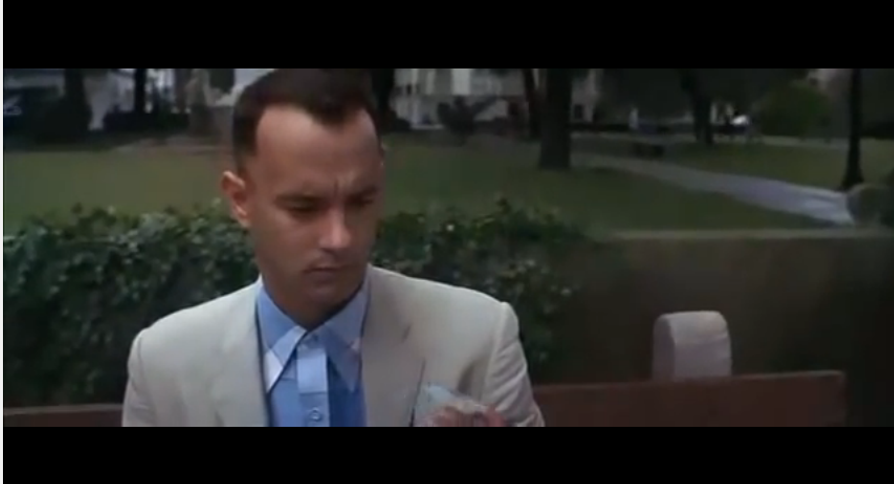
The feather moves closer and closer to this man in the white suit, and eventually lands at his feet at 1:56. The use of the shot when the feather lands at the man's feet allows the director to control how quickly the identity of the man is displayed to the audience. We then see the hand pick up the feather, as the camera pans up the man's body, stopping at his face. This is the audience's first close up glimpse of whom
they assume to be the main character. The man then opens the suitcase next to him, pulls out a Curious George book and places the feather in the back of the book. He closes the suitcase, and the camera pans back up to his face, as he looks on into the distance. The audience then hears the sound of a bus, and a wide shot is used as the bus pulls up. As the bus passes along the screen, we see the number 1981 written on the side of it, hence communicating the time of the film to the audience. The scene ends with the bus pulled up at the bus stop, and the man sat on the bench, presumably waiting to get on the bus.